If you have spent any time shopping for a guitar lately, you have probably run into the stainless steel frets debate. Some players swear stainless is the only way to go. Others insist nickel silver sounds warmer and that the whole thing is just preference. I make guitar content, and every time I mention stainless frets in a review, my comments fill up with the same arguments.
So let me settle it. Here is the honest breakdown of stainless steel frets vs nickel silver frets, covering tone, feel, durability, and the real cost most people never talk about. My take, if you are buying a new guitar and stainless frets are on the spec sheet, take them. But let me actually show you why instead of just telling you.
Quick disclaimer before anyone panics. I am not telling you to throw out your nickel fret guitars. If you already own one, play it and enjoy it. This is about what to prioritize when you are choosing your next guitar. If you are debating between two guitars and one has stainless frets, that is the tiebreaker.
What Is the Difference Between Stainless Steel and Nickel Silver Frets?
Nickel silver has been the standard fret material for decades. Despite the name it is not actually silver, it is an alloy of nickel, copper, and zinc. It is relatively soft, which makes it easy for techs to work on and gives it a traditional feel that generations of players grew up with.
Stainless steel frets are much harder. That hardness is the source of basically every difference between the two, the tone, the feel, the durability, and the cost. Once you understand that stainless is simply a harder metal, the rest of the debate makes a lot more sense.
The Tone Argument: Do Stainless Steel Frets Sound Different?
This is the big one. The claim is that nickel silver has more warmth and stainless steel sounds brighter and more sterile, so nickel wins on tone.
Is there a difference? Sure, a small one. Because stainless is a harder material, the way the string interacts with it does lean slightly brighter. That part is real. But it is nowhere near as dramatic as people make it out to be.
Here is where the argument really falls apart though. Think about your actual signal chain. You plug into an amp, you set your EQ, you add distortion, you stack on your effects. By the time your tone comes out of the speaker, all of that is shaping your sound far more than a fret ever could. Are you honestly telling me you can pick out a tiny bit of fret brightness underneath all of that? The tone argument basically dies the second you plug in.
And do not just take my word for it. Eddie Van Halen, arguably the greatest guitarist of all time, switched to stainless steel frets and never looked back. His playing was so aggressive he used to wear out his frets and have them replaced every couple of months, until stainless finally solved it. In his Guitar World interview, he said anyone who thinks stainless takes away from tone is crazy, that it has nothing to do with tone.
So you can trust the legend himself, or you can trust a random comment. I am going with Eddie.
The Bending Feel: This One Is Actually Legit
Unlike tone, the feel of bending is something you can genuinely notice, so I will give this argument real credit. Stainless steel is harder and smoother, so bends feel easy and effortless, and because the frets do not wear down, that smoothness stays consistent over time.
Some players actually prefer a little more resistance and grip under the fingers, and that is a completely fair preference. But let us be real. Most of us are not touring musicians who need the exact same feel night after night. For the average player, going from nickel to stainless is not going to break your immersion. You adjust in a couple of weeks, the same way you would after switching string gauges.
Do Stainless Steel Frets Wear Out Your Strings Faster?
You might hear that stainless, being harder, wears your strings down a little quicker. In theory, true. In practice, it barely matters. If you are changing your strings every one to three months like you probably should be, they are going in the trash long before fret wear becomes a factor.
Worst case, you buy an $8-12 pack of strings slightly sooner. I will take that over a $400 refret any day.
The “It’s Just Preference” Trap
Here is the part I really want to call out. The second you challenge the tone claim, the argument almost always shifts from “nickel sounds better” to “well, it’s just preference.” But those are two different things. Preference means “I like this.” It does not mean nickel silver frets are objectively better, or the right call for someone new to guitar.
Do not sell someone on tone as the reason, then retreat to preference the moment the facts do not hold up.
Stainless Steel Frets Are Going Mainstream
Stainless used to be a boutique, high end feature. Not anymore. The Epiphone Les Paul Modern Custom retails for around $799 and comes with stainless steel frets standard. That is not a high end Gibson or a custom shop instrument, it is an everyday player.
And the manufacturers clearly see the writing on the wall. ESP made stainless steel frets standard across their entire LTD 1000 series back in 2021 after it became one of their most requested features, and in 2024 they rolled it out across the Japan built E-II line too. Once companies like Epiphone and ESP start putting stainless on attainable guitars, it opens the floodgates. Expect to see it on more and more guitars across every price point.
The Real Argument: What Nickel Frets Actually Cost You
This is the part nobody wants to talk about. Say you buy that $799 guitar with nickel frets and you play consistently, a few hours a week. From what I have found, that kind of playtime can start showing fret wear somewhere around the five year mark.
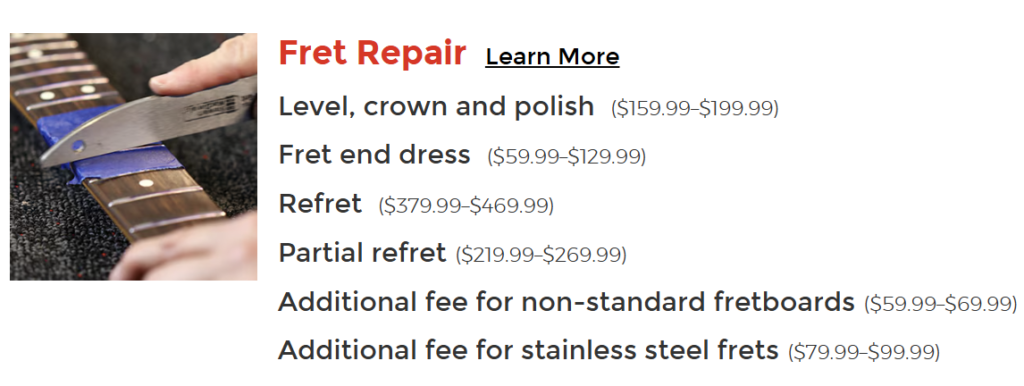
At first you would not need a full replacement, just a level and dress, filing the frets down and polishing them even again. That runs around one hundred fifty to two hundred dollars. But you do not get to do that forever. Every level shaves off a little height, so you might get two or three before there is not enough fret left and you need the full refret anyway.
A full refret runs $400 and up. On a $799 guitar, that is over half of what you paid. And this is not a DIY job unless you really know what you are doing, because it means stripping the old frets without wrecking the fingerboard, seating and leveling new wire, crowning, dressing the ends, and redoing the setup. On a guitar with neck binding like a Les Paul, that job gets even more involved and the price climbs higher.
At that point, unless the guitar has real sentimental value, a lot of people would just upgrade to something new instead of paying nearly the guitar’s value to refret it.
Now to be fair, if you only pick up the guitar here and there over the years, you may never wear out your frets at all. This argument is not really for you. But if you are new and getting serious, playing several hours a day, or you are a gigging player out there night after night, this absolutely applies to you.
And even if you never wear your frets out, there is real value in the peace of mind. It is one less thing to ever worry about. It can even help resale, since a buyer looking at an older used guitar feels a lot more comfortable knowing the frets are stainless and almost certainly are not worn out.
The Verdict: Stainless Steel vs Nickel Silver Frets
Let us tally it up, analytically, no emotion.
Durability goes to stainless, no contest. Consistency over time goes to stainless, since the harder material barely changes. Corrosion resistance goes to stainless, and it removes the problem entirely for players with nickel allergies. Tone is a wash, there is a slight brightness difference at most, and it disappears once you plug in.
What does nickel have going for it? Two honest points. It is softer, so it is a little gentler on your strings. And there is the feel, some players like the resistance, and you really can feel it when nickel frets start to wear. Those are real, but they are not enough to outweigh everything else.
In the end, stainless steel wins overall.
So if you already own a nickel fret guitar, do not fret, play it. This is not about what you own, it is about what to prioritize next time. And if there is a guitar you love that only comes with nickel frets, still buy it, I am not telling you to pass on a guitar you want. I am just saying that if you have the choice between stainless steel and nickel, go stainless every time.
Links
Shop Epiphone Les Paul Modern Custom guitars at Reverb (affiliate link)
Epiphone Les Paul Modern Custom
Shop Gibson Les Paul Modern Figured at Reverb (affiliate link)