I’ve had the Epiphone Les Paul Modern Custom in Candy Red for a bit now, and I figured it was time to give it the full rundown. Honestly, I was excited when I first saw this guitar. I’d been wanting to grab an Epiphone Les Paul Modern to put alongside my Gibson Les Paul Modern Figured, and when I saw this one was a Custom variant with stainless steel frets, I couldn’t wait to get my hands on it.
Before I get into it, here’s a big thing worth knowing. This is a Gibson.com exclusive, meaning you’re not going to find this one sitting in a store. It’s only sold direct through Gibson’s website, so a lot of people probably haven’t even heard of it. It retails for $799 and currently comes in two colors, Candy Red and Translucent Ebony Burst. Honestly, at this price point with these specs, I don’t see how this wouldn’t sell out fast, and it turns out that’s exactly what’s happening, this thing keeps selling out and getting relisted as new stock comes in. This one comes with a mix of good and bad, so let’s get into it.
Build Quality and What Came Wrong
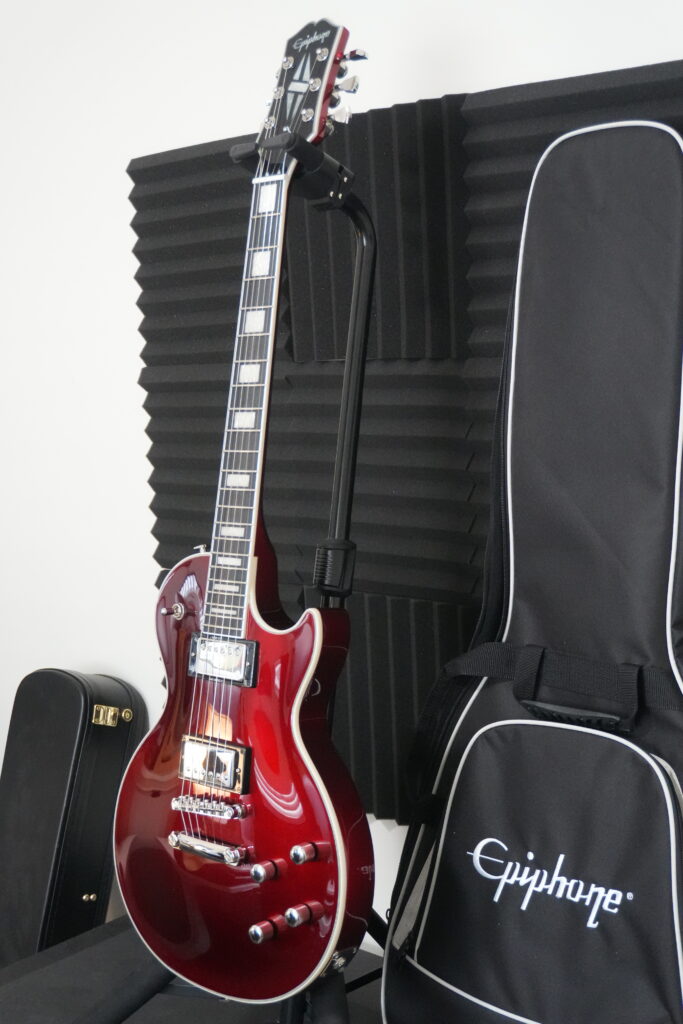
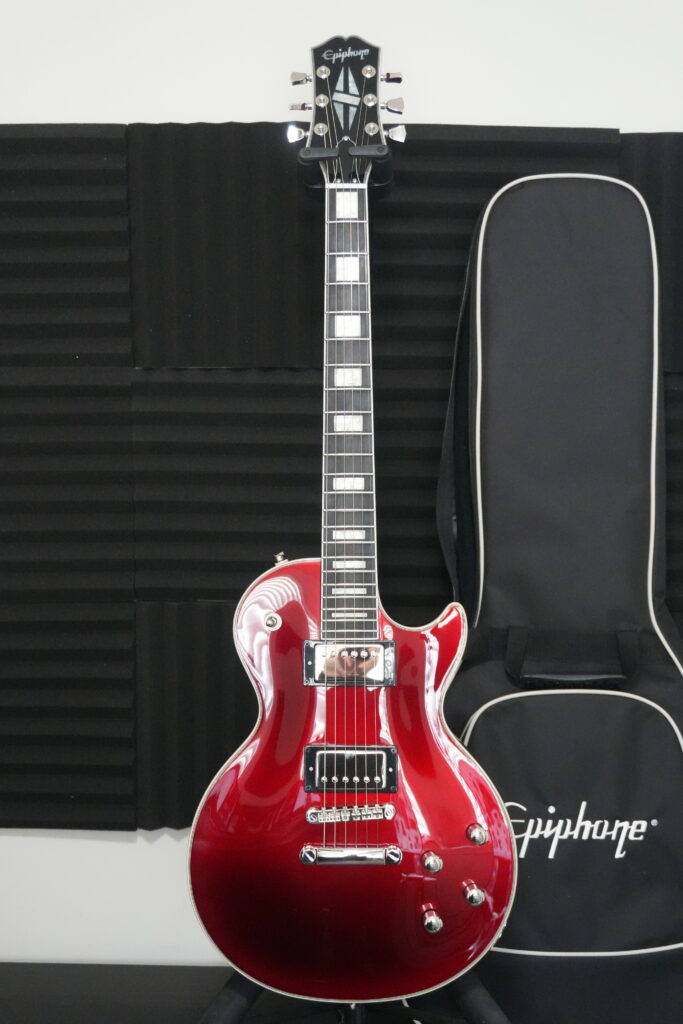
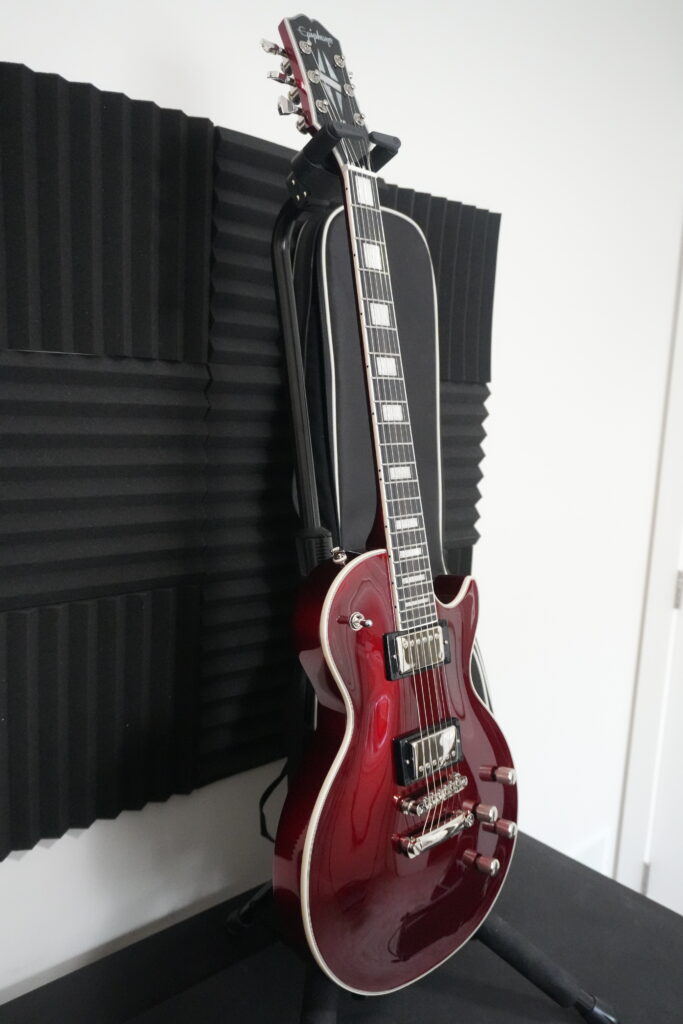
Right out of the box, this guitar looks great. Candy Red is a stunning finish, nickel hardware pops against it, and it has that classic Les Paul Custom look with some modern touches thrown in. However, mine didn’t arrive perfect. There’s a paint chip on the headstock and the knobs aren’t quite aligned right. A little disappointing, honestly, but nothing that ruins the guitar.
Quality control on guitars in this price range is always a bit of a gamble, and this is a good reminder to actually inspect your guitar closely when it shows up instead of just assuming everything’s fine. Besides those little things, this is still one of the better Epiphones I’ve received.
Doesn’t look like there are a lot of fret marks on this one either, and the stainless steel frets are pretty cool too, they’ve actually got rounded off ends, so they feel smooth rather than sharp under your hand as you move up and down the neck.
Specs
Let me run through what you’re actually getting here, because it’s a solid spec sheet.
- Body: mahogany, and it’s weight relieved so it’s not going to wear you out on longer sessions, topped with a maple cap and an AAAA flame maple veneer on top of that.
- Neck: mahogany with a 60s SlimTaper C profile, and the neck joint is contoured so you’re not fighting the heel to get up to the higher frets
- Fingerboard: ebony, with a compound radius that goes from 10 inches down at the nut to 14 inches up by the higher frets, so it’s comfortable for chords low and bends up high
- Frets: 22 medium jumbo, stainless steel, so they should hold up well over time
- Scale length is 24.75 inches, standard Les Paul territory
- Headstock is bound with that 60s Kalamazoo shape, mother of pearl inlay
- Locking Grover tuners, Graph Tech nut for tuning stability
- Tune-O-Matic bridge and stopbar tailpiece
- T-Type PRO pickups
- Two volume, two tone, coil splitting and a phase switch, three way selector
- Comes with a gig bag, runs around $799
Worth pointing out too, the body and neck are both bound with that thin pinstripe trim running around the edges, and you can really see it catch the light when you pan across the guitar. Combined with those pearloid block inlays running up the fretboard, it just looks like a genuinely upscale instrument, not something in the budget tier.
Playability
Playability wise, this guitar feels good. Comfortable neck, sits nicely, nothing awkward about how it handles. If you’re coming from a standard Les Paul style guitar, you’ll feel right at home here.
The Pickups: T-Type PRO
This is where I want to spend some real time, because there’s a lot of confusion floating around about these pickups, and I think a lot of people are judging them by the wrong standard.
The T-Type PRO pickups in this guitar are modeled after the Gibson T-Top humbucker, which was Gibson’s standard pickup through most of the late 60s into the 70s. These aren’t trying to be a PAF clone. They’re chasing a different era entirely, a slightly hotter, clearer, more articulate tone than the original PAF, which is exactly what a lot of 70s rock guitarists were reaching for.
And I mean real guitarists. Pete Townshend and Chuck Berry both played through T-Tops or T-Top style pickups. AC/DC’s Angus Young, Jimmy Page, and B.B. King all made iconic recordings with these pickups in their guitars during that era. Kirk Hammett’s 1979 Flying V, his first Gibson and the guitar behind Metallica’s early albums, shipped with T-Tops from the factory. He later swapped them for EMGs, but Epiphone’s new Kirk Hammett 1979 Flying V reissue loads Gibson’s own T-Type pickups, the same lineage powering this Modern Custom. So if you’re into that classic 70s rock sound, this pickup has real legacy behind it.
Worth knowing too, Gibson themselves make a modern reissue of the vintage T-Top, and they call it the T-Type. So Epiphone’s T-Type PRO and Gibson’s own T-Type are both modern tributes to that same original 60s and 70s pickup.
Quick clarification since “classic rock” means different things to different people. When I say classic rock here, I mean the actual 70s era, Townshend, Page, that generation. Not the stuff I grew up on in the 90s and 2000s. This pickup is built around that older, original T-Top sound.
And here’s the thing that I think gets missed. Rock is genuinely having a real moment again right now. Guitar solos and classic rock influence are making a comeback, driven in large part by people getting tired of overproduced, AI assisted music and wanting something that actually feels real again. So when you look at this guitar through that lens, the T-Type PRO isn’t just an homage to the past, it’s built for exactly what’s coming back around right now. This isn’t a metal pickup or a high gain pickup, and it’s not trying to be. It’s built for that classic rock clarity and bite, and that happens to be precisely the sound a lot of players are chasing again.
If this is your first guitar, or you’re upgrading from something entry level, this is a genuinely great option. It’s built with that classic rock tone in mind, but it’s still versatile enough to handle other styles of rock too, not a one trick pony. You’re getting real tonal history in these pickups, and the rest of the build backs it up with real specs, not corners cut.
One Thing to Know: Quick Connect
If you ever think about swapping pickups down the line, know that this guitar uses Epiphone’s Quick Connect system. That means you can’t just drop a Gibson or a Seymour Duncan pickup in without an adapter or some rewiring. It’s not a dealbreaker, but it’s an extra step and an extra cost if you go that route later.
Final Verdict
Overall, this is a good guitar. Fits in the hand well, plays well, and looks great, I mean come on, look at that finish. It’s genuinely one of the prettiest guitars I own.
There is something holding me back a little though, and if I’m honest, I’m not entirely sure what it is. I still tend to reach for other guitars in my collection over this one, even though it’s one of my newer guitars. I recently picked up the Epiphone Les Paul Futura Custom, which is almost the same guitar spec wise minus a couple things, and I find myself gravitating toward that one more, partly because it has the ProBucker Ignite humbuckers in it, and those just line up a little closer to my own playstyle.
That said, I’m not giving up on this one. I’m going to keep playing it and see if it grows on me. And to be fair to the pickups, if they were put in here on purpose because this is the style right now with classic rock coming back around, then they did put the right pickups in this guitar. I can’t really fault it for being exactly what it’s built to be.
Links
Shop Epiphone Les Paul Modern Custom guitars at Reverb (affiliate link)
Epiphone Les Paul Modern Custom