I got back into playing guitar about four years ago. And when I say got back into it, I mean I basically started from scratch. I played a little as a teenager but never really went deep on gear. I didn’t know the difference between a $500 guitar and a $2,000 one. I wasn’t a gear guy yet.
So when I came back to it as an adult I had to learn everything the hard way. A big part of that was figuring out what I actually wanted to play, which meant buying a lot of guitars, realizing they weren’t right, and moving them along.
I’m not an expert. I’m just a regular player who figured some things out and wants to pass them along. If you’ve never really thought hard about how you’re buying gear, hopefully this saves you some money.
Because I left a lot of money on the table before I figured this out.
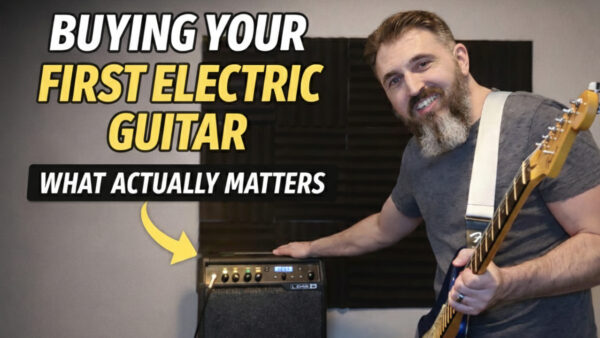
Before we get into it, a couple of things worth saying. If you are brand new to guitar, go into a store, get some help, and actually play a few guitars first. I put together a full guide on buying your first electric guitar if that’s where you’re at. At that stage you can cover a guitar, amp, and accessories for $300 to $500 without getting upsold, and buying new makes total sense.
And honestly even beyond that, buying new isn’t a bad thing at all. No wear, no mystery history, no wondering how the previous owner treated it. There is just something about getting a fresh guitar that feels good. This isn’t about saying new is wrong. It’s about going in with your eyes open so you can make the smartest decision for where you’re at.
What I’m really talking about is once you know what you like and start chasing better gear. That’s where buying used starts making a lot more sense.
New Guitars Lose Value the Moment You Buy Them
Almost every guitar you buy new is worth less the moment you take it home. This is just how the market works.
Go look at used Gibson Les Paul Standards on Reverb right now. Retail is somewhere in the $2,500 to $3,000 range. You will find a ton of them selling for $1,600 to $2,000. Someone bought those guitars new, played them for a while, and now the market has done the depreciation work for them.
That loss is your opportunity.
Buying used isn’t just about saving money on the same guitar you would have bought new. It can put a guitar in your hands you never thought you could afford. I picked up an ESP E-II Eclipse, which retails for around $2,799, for $1,700. That’s a guitar I probably wouldn’t have pulled the trigger on at full price. Sometimes buying used isn’t just the smart move, it’s the only way to get there.
There are guitars that appreciate over time, but generally those are higher-end instruments in the $4,000 plus range, limited runs, vintage pieces. The stuff most of us are buying in the $500 to $2,500 range is almost certainly going to be worth less the day you bring it home.
Now here’s where buying new really stings if you get into guitars and start wanting to try different things. The natural instinct is to just walk into a store and trade it in. But what a lot of people don’t realize is that retailers will only give you 40 to 50 percent of the used market value of the guitar, not what you paid retail. Not even close to what you paid retail. So that $1,900 guitar you played for a year might get you $700 to $800 if you walk it through the door. I know because I’ve been on the wrong side of that deal more than once.
I bought a Fender Ultra Strat new for $1,900. A year later I tried to trade it in and was only offered around $800 for it. I ended up selling it myself and netted around $1,200 after fees and shipping. That stung. But if I had bought it used for around $1,400 and sold it for the same, I would have barely taken a hit. And for what it’s worth I’d always recommend selling yourself over trading in, but that’s a whole other conversation.
Now if you only buy a guitar once every few years and rarely let anything go, the selling side of this matters a lot less to you. But even then, having that depreciation already baked in is worth something. Life happens. Job situations change. If you ever need to move gear quickly you want to already be on the right side of that curve rather than taking a massive hit on top of everything else.
One counterargument you’ll hear is the warranty. And look, it’s a fair point worth addressing. Gibson, Fender, and PRS all offer warranties on new guitars. But here’s the thing. What you’d really want covered is accidental damage, not manufacturing defects. Drop your guitar and snap the headstock, that’s the kind of thing people actually worry about, and none of these warranties cover that regardless of whether you bought new or used. They only cover the original purchaser, they don’t transfer to used buyers, and they’re really there for defects in the hardware or electronics, which usually show up early and get sorted before a guitar ends up on the used market anyway. For most everyday players the warranty is less of a factor than it sounds like on paper. And if you are someone who is rough enough on gear to actually need accidental coverage, well, that’s exactly the kind of player who should just buy used anyways since none of these warranties protect you there either way.
Beyond depreciation, buying used means someone else has already taken the hit on whatever quirks a guitar might have. If something was wrong out of the box, there’s a good chance it got returned or fixed before landing back on the market. A guitar that’s been out in the world a year or two has a track record. That said there are lemons, which is exactly why buying through a reputable platform with seller protection matters.
If you like a guitar but want something changed out, buying used is a great way to go. Swapping pickups, different hardware, whatever you want. Just know your customizations probably won’t add value if you decide to sell. I had an ESP LTD EC-1000T CTM that I upgraded with Fishman Fluence Modern pickups. Did it sell for a little more than stock? Probably. Did it make up for the $300 I spent on pickups? Not even close. Most buyers want stock so keep that in mind.
One more thing. A used guitar might not come set up correctly and will probably need new strings. If you can’t do a basic setup yourself, factor in a trip to a local shop or luthier. It’s worth learning the basics so you can do some tweaking on your own. Even with that added cost you’ll almost certainly still come out ahead compared to buying new.
Do Your Homework Before You Buy Anything
Before you buy anything, new or used, do your research.
Sold listings on Reverb and eBay will tell you what a guitar is actually worth right now, not what someone hopes to get for it. That knowledge also arms you when it comes to negotiating.
If you’re at a local shop looking at used gear, guitar stores typically pay 40 to 50 percent of their used selling price when they acquire inventory. So if a guitar is on the wall for $1,000 used, the store probably paid $400 to $500 for it. There is real wiggle room there. Don’t be afraid to ask if they can do $700 or $800. Worst they can say is no.
And even if you end up buying new, don’t assume the sticker price is the only price. Local shops and places like Sweetwater will often work with you. At Sweetwater you typically get assigned a sales rep. Some will toe the company line. If that happens, try calling off hours and talking to someone else. I’ve gotten anywhere from 10 to 20 percent off just by asking the right person. Eventually I found a rep who works with me on prices and that relationship is worth a lot.
Guitar Center is a different story on used gear. They are notorious for not budging on prices. Corporate sets them and most staff don’t have the authority to move on them. Don’t waste your time. That said, Guitar Center mislabels guitars all the time so browsing their used gear online is actually worth doing. Wrong model, wrong year, sometimes completely the wrong guitar. If you know what you’re looking for and can spot inconsistencies in the photos you can sometimes snag a great deal. You have 45 days to return used gear so the risk is manageable.
Where to Buy Used and What to Look For
In a perfect world every used guitar you wanted would be sitting at your local shop ready to play. The reality is you are going to have to search, and most of that searching happens online.
Reverb is probably the most popular platform for used gear. Good selection, built in protections, and you can get a sense of a seller from their feedback. If a seller has a ton of positive transactions, there’s a good chance they’re a small shop with their own website. You can often reach out directly and get a better deal by cutting out the platform fees. I’m just telling you what I’ve done. How much risk you’re comfortable with is your call.
eBay is another solid option. I know some people don’t like it but I’ve bought and sold a few things there with no problems and their buyer protection is solid.
Sweetwater Marketplace is worth keeping an eye on. Good platform, decent protections, and worth browsing regularly.
Facebook Marketplace can work if you find a local deal you can inspect in person. I’ve found some deals on there worth checking out. One big advantage of buying local is you skip taxes and shipping entirely, which adds up on a higher priced guitar. Just go in with realistic expectations.
Craigslist is worth a mention. Same deal with local pickup but be aware of fakes and overpriced listings. I haven’t had much luck there and from what I’ve read online a lot of people feel the same way lately. It’s dried up. Still worth a look but keep your expectations in check.
On condition, I’d stick to very good or better. That means no hidden damage, no cracks, no repaired breaks, and frets that still have plenty of life left in them. A lot of platforms use standardized condition ratings so learn what those mean before you buy. Very good means some minor cosmetic wear but nothing structural. Anything below that and you’re rolling the dice unless you know how to assess and fix things yourself. If a listing is vague or photos don’t show you enough, just ask for more. Most sellers will send more pictures without hesitation and as a seller myself I’ve never minded it.
The right guitar might not show up right away. Keep checking back. Something almost always comes up if you’re patient.
A Word on Scams and Fakes
Scams happen. A few things are worth knowing.
One common one is lifted photos. The guitar looks completely real because the images are pulled from another legitimate listing or a retailer’s website. You pay and either nothing shows up or something completely different does. This is especially common on Facebook Marketplace and Craigslist. If someone asks you to send money through a payment app with no platform protection, walk away. There will be no guitar.
Fake guitars are out there too. More common on higher end instruments like Gibson Les Pauls than something like an Epiphone, but it does happen. Guitar Center has even sold fake guitars. It happens on reputable platforms too.
Stick to established marketplaces with real return policies. The more reputable the platform, the more tools you have if something goes wrong. When buying online you are going off photos and descriptions so condition rating, seller reputation and return policies are everything.
On the payment side, if you do find a guitar through Facebook Marketplace, Craigslist, or anywhere outside an established platform, PayPal Goods and Services can offer you some protection. Just know that if someone asks you to pay through PayPal Friends and Family, walk away. That is a red flag. Friends and Family has zero buyer protection and that’s exactly why scammers push for it. For established platforms like Reverb and Sweetwater, using a credit card where possible is even better because you have federal chargeback rights that go beyond what any platform offers on its own.
I bought my Fender Showmaster on Facebook Marketplace and paid via PayPal outside the platform, which probably wasn’t the smartest move. But I used Goods and Services so I had some protection and it worked out. We can all get taken, sometimes you just have to use your best judgement.
My Greatest Score
This one still gets me. I found a Gibson Les Paul Modern Figured in Cobalt Blue on Sweetwater Marketplace listed for $1,550. Barely played, a few months old based on the serial number, and it came with Sweetwater paperwork showing it had been professionally plekked with a nut upgrade already done.
Retail on this guitar is $2,999. That’s already $1,450 under retail. But then factor in the Plek Pro setup which runs $299 at Sweetwater, plus the nut upgrade on top of that, and you’re looking at somewhere around $400 to $500 in professional work already done. So realistically I’m getting what is essentially a new guitar with premium upgrades for close to $1,850 less than what that would have cost me going the new route.
It showed up and it was better than I expected. Every bit of the paperwork checked out.
This probably isn’t the norm. But every once in a while you score a killer deal and it makes the whole approach worth it.
The Bottom Line
Will I literally never buy a new guitar again? Probably not. But that’s kind of the point. The title isn’t a hard rule, it’s a mindset. It’s about going into any purchase with all the facts instead of just walking into a store and paying whatever the tag says.
Know what the guitar sells for used. Know what it’s going to be worth if you decide to move on. Know that you can almost always negotiate whether buying new or used. And know that the used market might just have exactly what you want at a price that makes a lot more sense.
If you cycle through a lot of guitars like I do, buying used protects you from eating that depreciation hit every time you want to try something different. And if you want to stretch your budget, the used market can put a higher end guitar in your hands that you might never have been able to afford new.
Honestly, if you’re someone who likes trying out different guitars fairly often, buying used and reselling later starts to feel less like a purchase and more like a renting fee. The depreciation is already built in, so what you’re really paying for is the time you get to spend with the guitar.
That’s what this is really about. Not swearing off new guitars forever. Just making sure that whenever you do buy, you’re making the smartest decision you can.