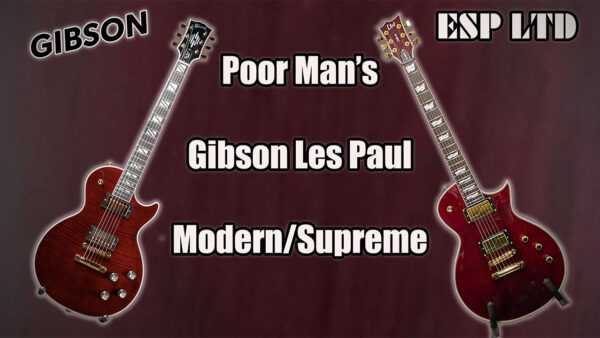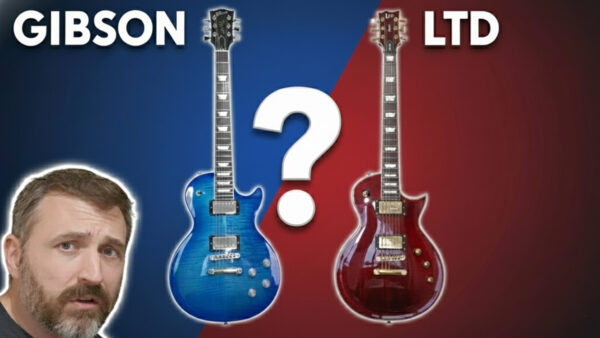
I’ve owned both an LTD EC-1000 and an ESP E-II Eclipse, and for most players, I think the EC-1000 makes more sense. The E-II is a great guitar. It’s just hard to justify paying close to double.
Ever since I got back into playing, I’ve been a big fan of the EC-1000 series. Great specs, they play fantastic, and they’re a great value. But every time I say that, I hear the same two comments. One is that LTD is just ESP’s budget brand. The other is that if it’s not made in Japan, it’s not worth it. “Just spend a little more and get yourself a Japanese E-II.”
So let’s break it down. And to be clear up front, I’m not saying don’t buy an E-II. I owned two of them, and they were fantastic. I’m saying that when you actually look at the specs and the price, it gets really hard to justify.
Both are factory guitars
The E-II is not a hand built guitar. ESP says so on its own website, describing E-II models as their highest quality instruments that are factory produced.
I’ll admit, when I bought my first E-II, I assumed it was handcrafted. I was used to Gibson talking about guitars being handcrafted in Nashville, and you’re paying around $3,000 either way. So I figured that kind of money must mean hand built. It doesn’t. The truly handcrafted ESPs come out of the ESP Custom Shop in Japan, and that’s a whole different price range. That doesn’t mean E-IIs don’t get hand work like sanding and finishing. They’re just built in a factory.
LTDs are made in larger quantities on an assembly line, according to ESP. Assembly line doesn’t mean robots build the whole thing. It usually means each person handles one step, with good machines doing the precise work. That kind of setup is actually great for consistency.
Japan vs Korea
Japan has a reputation for building some of the best guitars in the world, and I’m not going to argue with that. LTDs are made in factories around Asia, including Korea, Indonesia, and China, per ESP.
Korea has a strong reputation too. A common ranking you’ll see online puts China and Indonesia near the bottom, then Mexico and Korea, with the USA and Japan at the top. Schecter’s Michael Ciravolo has described a similar order. Honestly though, the specific factory matters more than the country.
One heads up: not every EC-1000 is made in Korea anymore. Some are made in Indonesia. Plenty of people say those are great too, but personally I only buy the Korean ones. Every LTD I’ve owned has been Korean built, including my current EC-1000. Check the headstock or the listing before you buy.
LTD isn’t one thing
When someone calls LTD a budget brand, my first question is always, which LTD? The Eclipse lineup alone runs from about $400 to around $1,500.
Even ESP doesn’t frame LTD as a budget line. Its website says LTD covers everyone from beginning players to serious working musicians. ESP also says the LTD Deluxe, meaning the 1000 series like the EC-1000, is a level of quality any serious performer would be proud to use at important gigs.
| LTD Eclipse model | Approx. new price (2026) |
|---|---|
| EC-200DX | $399 |
| EC-256 | $599 |
| EC-401 | about $999 |
| EC-1000 series | $1,099 and up |
So when someone says “ew, that’s a budget guitar,” are we talking about an entry level EC-200DX or an EC-1000? Those are not the same guitar.
What’s actually different
Let’s be fair here. The E-II does have some real upgrades. It’s made in ESP’s own factory in Japan, with a bone nut, Gotoh hardware, a maple top on most models, and a hardshell case. Specs vary by model, so think of this as a general comparison of the two lines.
| Spec | ESP E-II Eclipse | LTD EC-1000 |
|---|---|---|
| Made in | Japan, in ESP’s own factory | Korea or Indonesia |
| Nut | Bone | Molded |
| Tuners | Gotoh locking | LTD locking on most |
| Bridge | Gotoh TOM and tailpiece | TonePros locking TOM and tailpiece on most |
| Top | Maple top or cap on most | Plain mahogany or a maple top, depending on the model |
| Fretboard | Ebony, about 12″ radius | Macassar ebony, about 13.78″ radius |
| Frets | 22 stainless (all models since 2024) | 24 stainless on most (22 on T models), since 2021 |
| Pickups | Premium pickups, like Fishman Fluence or EMG | Premium pickups, like Fishman Fluence, EMG, or Seymour Duncan |
| Case | Hardshell included | Not included |
| Price (new, 2026) | About $2,700 to $3,100 | $1,099 and up |
About that case. The official ESP EC form fit case is about $179, and it’s the same case that fits both guitars. Add it to an EC-1000 and you’re still way under an E-II.
Is the Japanese fit and finish a step up? Honestly, yes. My E-IIs felt a little more refined. My EC-1000 showed up with a nut that was off by a smidge, and that was it. That’s an easy fix, and buying from a store with a good return policy covers you.
What about the wood?
ESP lists mahogany bodies and mahogany necks on both. Most E-IIs add a maple top, and some LTDs get one too, like the EC-1000T with a maple cap.
The EC-1000’s Macassar ebony is a real ebony species, the striped kind from Indonesia. Wood suppliers describe it as very dense and hard, with similar properties to African ebony. It just looks different, with brown streaks. Neither line publishes wood grades, so anyone telling you the E-II has better wood is guessing.
What they share
The E-II and the EC-1000 have a lot more in common than people think. Both give you:
- An ebony fretboard
- Stainless steel frets
- Premium pickups from Fishman, EMG, or Seymour Duncan, depending on the model
- Locking tuners
- A Thin U neck
- Set thru construction with that carved heel for easy upper fret access, on most E-II Eclipses
- A thinner body with a waist cut
The EC-1000 even adds 24 frets to the E-II’s 22, a flatter fretboard, and a locking bridge.
Here’s a fun one. LTD put stainless steel frets on the entire 1000 series in 2021. ESP made them standard on all E-IIs in January 2024. So the LTD 1000 series actually got that upgrade first. Just note it’s the 1000 series, not every LTD.
Same pickups, very different price
I’m going to compare this to Gibson and Epiphone a few times. I know it’s not apples to apples, but it’s the closest thing we have when people talk about a budget brand versus a premium brand.
With Gibson and Epiphone, one of the biggest debates is the pickups. That’s usually where the cheaper brand cuts corners. Here, that argument mostly goes away. E-IIs and EC-1000s both come with premium pickups, whether that’s Fishman Fluence, EMG, or Seymour Duncan. A big selling point the expensive guitar usually has just isn’t there.
My Tiger Eye had Fishman Fluence Moderns, ceramic in the bridge and alnico in the neck. My EC-1000 has the same setup, just the newer three voice version. The Tiger Eye only had two voicings. And for that, the Tiger Eye lists at $3,099 while the EC-1000 lists at $1,499. Even the cheaper E-II Eclipses run around $2,700, while EC-1000s start at $1,099. That’s where it gets hard to justify.
Legacy and the logo
With Gibson, part of what you’re paying for is the legacy. Jimmy Page, Slash, decades of history, the whole lifestyle. ESP has a legacy too. It started in Tokyo in 1975 as a shop selling replacement guitar parts. What really put ESP on the map was Metallica, along with players like George Lynch and Slayer. By the end of the 80s, Hetfield and Hammett were playing almost all ESP custom guitars. Custom guitars, not something you’d pull off the rack.
Here’s the part that stinks. The E-II used to be called the ESP Standard series, made in Japan with ESP right on the headstock. In 2014, ESP renamed it E-II, and now the headstock says E-II instead. Mine said “Designed and built by ESP” on the back. If you want that ESP logo on the headstock, you’re mostly looking at higher end models like an ESP USA Eclipse, which runs around $5,500.
Compare that to Fender, which puts Fender on a Mexican made Player II Strat that sells for under $900. I get why ESP did it. They probably want the ESP name to mean the high end stuff. But I think it was a pretty crappy move for the fans.
Judge the guitar, not the logo
I’m being a little tongue in cheek here, because a logo doesn’t make a guitar play better. But if you’re knocking an LTD because it doesn’t say ESP on the headstock, guess what? Neither does the E-II.
Flip my EC-1000 over and the back of the headstock says “Designed by ESP.” There are differences, like the fretboard radius, but the basic design is the same across LTD, E-II, and ESP. Same shapes, same headstock, same idea. ESP already has the template, so it’s a lot easier for a Korean factory to turn out a really solid guitar. They follow ESP’s guidelines, and ESP says it keeps strict quality standards on all LTDs.
You’ll get great ones and duds from any brand. So at least between LTD and E-II, judge the guitar, not the logo. ESP USA and the Custom Shop are a different conversation. I haven’t played those, and I’d assume they’re on a whole other level.
Gibson money
The Tiger Eye lists at $3,099. A 2026 Gibson Les Paul Standard ’50s is $2,799, and a Les Paul Modern Figured is $2,999. To be fair, the Les Paul is a factory guitar too, machine shaped and hand finished in Nashville, with a Custom Shop above it. I’m not saying an E-II is a Les Paul. I’m saying that for that kind of money, you could have one, and it actually says Gibson on the headstock.
No, I’m not coping
Before anyone says it, no, this isn’t me justifying my purchase because I can’t afford an E-II. I owned two, a 2024 Snow White Satin and a 2025 Tiger Eye Burst. I could have kept either one.
If I wanted the true premium ESP experience, I wouldn’t stop at an E-II. I’d go for an ESP USA, handcrafted in Southern California, or a Custom Shop ESP from Japan. That’s the real top of the line.
Why I kept the EC-1000
Since getting back into guitar, I’ve owned a bunch of LTDs. An SN-1000HT, an EC-1000T CTM, a couple of EC-1000s, and now this Granite Sparkle. I buy and sell a lot, probably too much, but every time I refresh my lineup, I end up back at LTD.
The Tiger Eye E-II might be the best playing guitar I’ve ever owned. But was it worth double the price of my EC-1000? Not for me. I wanted a modern guitar. Ebony board, premium pickups, a set thru neck with great upper fret access, locking tuners, and a thinner body with a waist cut. I didn’t need to spend $3,100 to get that.
I also wanted Granite Sparkle. The E-II does come in Granite Sparkle, but that one has EMGs and a set neck with a chunkier heel. The combo I wanted, the sparkle, the Fishmans, the carved set thru heel, and 24 frets, only exists on the LTD. And it’s not just a spec sheet. It legit plays great and stays in tune.
Buying used
I’ve seen used E-II Eclipses listed around $1,700 to $1,800. A new EC-1000 Granite Sparkle lists at $1,499, and I paid about $1,300 all in. New also means no mystery wear, no missing case, and a full warranty.
E-IIs do tend to hold their value well. But since they cost so much more to begin with, you can still lose more actual dollars on one.
Used EC-1000s regularly show up for under $1,000, sometimes well under. Older ones also come with different pickups, like EMGs or Seymour Duncans, and tons of different colors.
Tips for buying a used EC-1000
- Go 2021 or newer if you want stainless frets, and double check the listing says stainless.
- Look for Korean made if that matters to you. Check the headstock or ask the seller.
- “EC-1000 Deluxe” is the same guitar. Deluxe is just ESP’s name for the LTD 1000 series.
Want something more traditional?
Look at the EC-1000T and EC-1000T CTM. They have full thickness bodies with a maple cap, so they’re closer to a Les Paul feel, but they’re still set thru with the carved heel. The EC-1000T lists around $1,399, and I owned a CTM. And if you want a true traditional Les Paul feel, honestly, I’d just grab an Epiphone.
The bottom line
So is the E-II worth it? It’s a great guitar, but for most people, I think the EC-1000 is the smarter buy.
I’d give the E-II the edge in fit and finish, and I stand by everything I’ve said about mine. But when you break it down, the same pickups, stainless frets, a modern spec sheet, and the price, it’s hard to justify paying double or close to triple. And I’m not alone. A lot of owners who’ve had both say the E-II is a little nicer, but nowhere near worth double.
One last thing. If you’re buying new, always ask for a better price, because that number usually exists. And you can almost always find these used for less. The math on all of this changes the second you stop paying sticker.
All prices are approximate and current as of October 2026. They will change.
Links
Shop LTD EC-1000 and ESP E-II Eclipse guitars (affiliate links)
Sources
- ESP, What Are the Differences Between ESP’s Brands?
- ESP, FAQ
- ESP, stainless steel frets on all LTD Deluxe 1000 Series
- ESP, stainless steel frets on all E-II models
- ESP, E-II Eclipse specs
- ESP, LTD EC-1000 Granite Sparkle specs
- Guitar World, ESP’s 2023 E-II lineup
- guitarguitar, A Brief History of ESP Guitars
- Wikipedia, ESP Guitars
- Sweetwater InSync, Does It Matter Where Guitars Are Made?
- Maderas Barber, Macassar ebony
Some links on this site are affiliate links. If you buy through them I may earn a small commission at no additional cost to you.