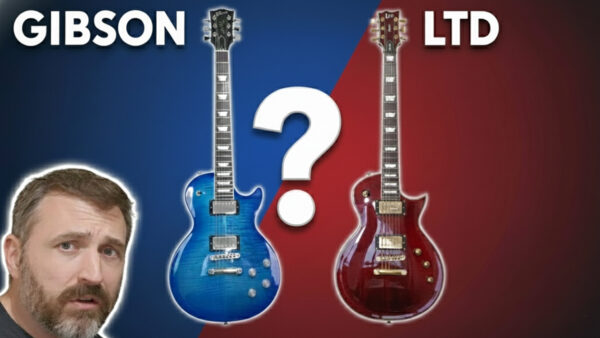
There’s no better time than right now to buy an Epiphone Les Paul.
But ew. It’s not a Gibson. Gross. Only poor people play Epiphones.
I don’t think that’s the case anymore, especially after about 2020, and this isn’t me telling you to buy an Epiphone over a Gibson. I’m not doing that at all. I own a Gibson, I like it, and there are a couple more I’m still saving for. I just want to clear up some misconceptions these guitars get and give them the respect they deserve, because the stuff people say about them is usually about a guitar Epiphones before they started to improve things.
Which Epiphone Les Paul did you actually play?
Epiphone Les Pauls run from a couple hundred bucks up to $1,300 plus, which is a huge spread to have under one name. So when somebody gives you their opinion on Epiphones, you really have to ask which guitar they played. Did they play the $300 bolt on neck one? Did they play one from 2002? Because that makes a huge difference. Older Epiphones were definitely more inconsistent than they are today, and honestly some of that reputation was earned. But if the last one you picked up was ten or fifteen years ago, you’re arguing about something that isn’t on the wall anymore. Go play a recent one. That’s all I’m asking.
Guitars in general are just better now
You can take a low end guitar today and it probably plays almost as well as a mid to high range guitar from 30 or 40 years ago. A lot of that is just modernized production. CNC machines carve tops and fretboards more accurately, which makes the guitars more consistent overall. Fret slots are the big one. The spacing and depth have to be exact or your intonation is off up the neck, and no setup in the world fixes a badly slotted board. That used to be one of the biggest things separating a cheap guitar from a good one, and now a machine does it the same way every time.
Gibson owns the factory
Here’s the part most people don’t know. A lot of guitar companies contract out to other factories to get their guitars built, but Gibson actually owns the Epiphone plant in Qingdao, China, where I’d assume most of the Les Pauls are made.
That matters more than it sounds like it does. Before that plant existed, Epiphones were coming out of contract shops like Samick and Unsung, and those places build guitars for whoever pays them. Your Epiphone was rolling off the same line as somebody else’s brand, built off a spec sheet handed over by a company that wasn’t even in the building. Gibson opened Qingdao in the early 2000s under a Gibson luthier named Mike Voltz, and there’s an interview from 2016 with the guys running the place, Scott Lewis and Lloyd Williams, where they say it pretty plainly. They’re Epiphone employees at an Epiphone factory, they take ownership of the guitars in a way a contract manufacturer can’t, and they’ve got access to proprietary manufacturing techniques from Gibson. So it’s not some random person making it.
2020 is when things really changed
It got announced at NAMM that they were resetting the whole slate, and that’s when Epiphones became Inspired by Gibson. They changed over to the Kalamazoo headstock, and when building the guitars they went back to the original blueprints and started staying a lot closer to spec than they had before. Around that same time they also upgraded the electronics across the line.
The pickups are worth a minute here since that’s where everybody loves to say they are bad. The ProBucker showed up in the early 2010s and replaced the generic humbuckers Epiphone had been using, and Epiphone’s own announcement says they were completely designed in Nashville and tooled from the ground up at a new factory built for high end pickup production. Nashville is Gibson’s house. They’re built to Gibson’s specs using the same materials Gibson uses in their own pickups. So the guy telling you the pickups are junk is talking about a pickup that hasn’t been in these guitars for over a decade.
Then around 2024, when they started Inspired by Gibson Custom, they started giving us guitars with the actual Gibson headstock on them. The shape had shown up on some Epiphones back in the late 90s and early 2000s, but it went away after the 2018 takeover, and the Kirk Hammett Greeny was the one that brought it back.
They can take more chances than Gibson
This is one of the things I actually like about Epiphone. They can create new guitars and bring back old classics at a price where regular people can actually play them.
Look at the Widow. Guitar Center and Epiphone did a Les Paul Custom Widow with color matched binding running all the way around the body and the headstock, flame maple top, ebony board. Seven hundred and ninety nine dollars. Now go look up the original. The Black Widow was a Custom Shop cult guitar from around 2009, and MusicRadar described them as rare as hen’s teeth, with quilted maple Red Burst examples listed online for ten grand. $10,000, or $799. Same deal with the Bats in Flight, which started as a Gibson and Guitar Center collaboration back in 2019 and was ultrarare. They brought it back in 2025 and included an Epiphone version for the first time.
The three I own
The Cobra Burst is an Inspired by Gibson Custom Les Paul Custom, a Sweetwater exclusive at $1,299. It’s built to spec minus not having the nitro finish, unfortunately, but you still get the USA Gibson made humbuckers, the 490R and 498T, ebony fretboard, the Gibson headstock with the custom logo, Grover tuners, hardshell case, all that good stuff you’d expect in a Gibson Les Paul Custom.
The Futura is $899 and these are newer guitars that people really like. Weight relief, carved heel in the back, Grover locking tuners, compound radius fretboard, custom made Ignite Epiphone humbuckers, push pull, awesome paint job, and I could go on and on about this thing. And on top of all that, stainless steel frets on an $899 guitar. Pretty awesome.
The Modern Custom is a Gibson.com exclusive at $799, and it’s the one I’ve been reaching for most lately. Weight relief, compound radius fretboard, the custom inlay, Grover locking tuners, ebony fretboard, one heck of a paint job, and this one has stainless steel frets too. The thing’s just awesome.
Before you call me a hater
I’ve also got a Gibson Les Paul Modern Figured, which is $2,999. I’m not trying to steer you away from buying Gibsons, they’re great guitars in their own right and I’m glad I’ve got this one.
But if you walked into a shop and couldn’t see the headstock and put that one next to the Modern Custom, you’d find very similar specs. Weight relief, ebony fretboard, carved heels, Grover locking tuners, awesome looking finishes. Which one would you grab?
I don’t know. That’d be kind of a rough decision.
Where Gibson actually wins
I’m not going to argue that quality control couldn’t use some work, and I’ve got videos on it. But I’ve had QC issues with other brands too, and on the last couple Epiphones I bought the quality has seemed to be getting better. That’s going to vary person to person and I’m not speaking for Epiphone in general. It’s kind of the nature of the game.
Then there’s the wood thing. I had a comment come up recently where somebody said Epiphone gives you junk wood, the idea being that Gibson has a specific mahogany they use and classify and Epiphones use wood that isn’t mahogany but has similar characteristics. So I went and looked into it. Genuine mahogany is Swietenia macrophylla, and it went on CITES Appendix II back in 2003, so nobody can just pull it off a shelf the way they could in 1959. What Gibson has is an agreement ratified in 2012 giving them an exclusive deal on the highest grade mahogany Fiji produces. Here’s the part people get wrong though. Fijian mahogany is the exact same species as genuine Honduran mahogany, just plantation grown, which is why it’s still available. It’s not a different wood or a better wood. It’s the same wood at a better grade.
So yeah, I’d assume Gibson takes the higher quality pieces, and at that price I’d expect them to. But go look at Gibson’s own spec page for a Les Paul Standard 50s. Body material: Mahogany. That’s the whole entry. Then go look at the Epiphone page on the same website, and it says mahogany body, mahogany neck. Same word, no species, same company. They don’t publish any of it. So the guy in your comments confidently explaining Gibson’s mahogany classification is guessing, same as everybody else. He might be guessing in the right direction, but he’s guessing.
There are two differences that are real, though. When you get a flame top on a Gibson you’re getting a solid piece, where on these Epiphones you’re getting a veneer, a thin layer on top. And I’ve read that Epiphone glues more pieces of wood together in their construction than Gibson does. Again, if I’m paying a Gibson price I’d expect that. But does any of that equate to oh man, my guitar sounds so much better, or oh man, I should be spending thousands more? It’s kind of hard to justify that.
Gibson’s actual problem
These Epiphones are coming up in quality, they’re producing guitars with the Gibson headstock, they’re creating awesome new guitars. So what does Gibson have left?
What Gibson has is a lifestyle brand. You’re a big baller, you’re a rock and roller, buy the Gibson. Epiphone is just the little brother, the annoying little brother, don’t worry about him, come over here to Gibson. I think that kind of sucks, especially since Gibson owns the Epiphone factory that makes the majority of their guitars. They need to unify. I mean, look at Apple. An Apple is an Apple. Their lowest tier phone is still an Apple, their lowest iPad is still an Apple. What’s going on, guys?
Just give it the headstock
Hear me out on this one. Any Les Paul Standard and higher should just get the Gibson headstock. They’re already putting it on the Inspired by Gibson Custom stuff so it’s not a hard lift, and then you’ve got a guitar like the Futura. Look at all those specs. That guitar deserves the headstock, it’s $899 and it’s not Inspired by Gibson Custom, I don’t care. It’s very deserving of it in my opinion.
And look at Fender. Even Squier guitars get the Fender headstock shape, they just put a Squier logo on it, and Fender made that call on purpose back in 1982 so buyers would know it wasn’t the American product. Shape yes, logo no. So even if you leave Epiphone up there I don’t see what the big deal is. I’d almost argue go ahead and put Gibson up there, put a big Made in China stamp on the back, huge, so there’s no denying it, and you’re good to go.
I know this is going to hurt the Gibson purist and I can already see the comments. Well, it’s made in China, it’s not American made, the heritage, blah blah blah. Okay. I know you’ve got to protect your investment. You’ve got to feel superior over the rest of the guitar playing population. I get it. I honestly do get it.
Epiphone also gets a bad rap because you’ve got to have controversial YouTube videos, so I see a lot of videos dogging on Epiphone for no reason because you’ve got to get those views. Well, this little thing’s wrong and I disassembled the whole guitar. You could speculate and pick apart just about any guitar and do that. A lot of the time people have an agenda and they want you to click those affiliate links and buy the most expensive stuff so they make a bigger profit. I’ve got affiliate links in this post too, for what it’s worth. The difference is I’m telling you the $799 one is good.
“Just save up for a real Gibson”
One of the big things I read, especially about the Inspired by Gibson Custom guitars, is if you’re paying $1,200 plus why don’t you just save up another $400 and get a Gibson Les Paul Standard. And notice they said Standard. Nobody ever mentions the Studios.
So chances are you’re buying that used from Guitar Center or Reverb or maybe your local shop has one, which means you’ve got to factor in taxes and shipping on top, so it’s not quite $1,700 on the nose. And remember, and I say this in every video I make, you never buy a new guitar at full retail price. Always ask for a discount. At a minimum you should get 10% off and usually you can get around 15%. I got my Inspired by Gibson Custom out the door for a little under $1,200 with taxes and shipping included. So now go back to that used Standard at $1,700 plus tax and shipping, and that gap widens. Now it’s more like a $600 or $700 gap. And if you can find one of them used, you’re paying even less and the gap opens up further. When you tell me to buy used, that argument cuts both ways.
But here’s the real thing. I like the Cobra Burst. I wanted the Epiphone Les Paul Custom. I didn’t say I wanted a Standard. I wanted the custom spec guitar, I wanted that finish, and I’m not going to find it for under $5,000 anywhere. Gibson’s version of it is a Custom Shop order, and those start north of five grand. So how much do I have to save? I’m saving four and a half or five thousand dollars to get the same guitar with a Gibson logo on it? That kind of stinks. You actually have to enjoy the guitar you’re playing, and just because it says Gibson on it doesn’t mean it’s going to inspire you to pick it up.
Nobody ever says buy a Studio
Here’s what I find funny about all this. You never hear anyone saying why don’t you just buy a Gibson Les Paul Studio.
If you’re like me, you’re a full flavored man. You want the binding on the fretboard and on the body, and the older Studios don’t have that. The new ones have come a long way though. At least you get fretboard binding now, and they’re doing different flavors of pickups across the lineup. The base Studio is $1,599, the Studio Modern is $1,799, and the Studio Session is $1,999. Even with the bound fretboard I’m still not paying two grand for one, because I’d just throw the argument right back. For that money I could buy a used Standard or a used Modern.
So should you buy one
I’m not saying don’t buy a Gibson at all. I think they’re fantastic guitars, and I’ve still got a couple white whales out there I’m looking to buy.
I just wanted to clear up those misconceptions, because it’s not oh, that guy can’t afford a Gibson so he has to play an Epiphone. I don’t think so at all. Things have changed a lot even in the past five years. The quality has gotten a lot better, they’re knocking it out of the park with the Inspired by Gibson Custom lineup and the Gibson headstock, they’re creating stuff like the Futura, they’re adding stainless steel frets and doing cool innovations Gibson might not pick up on right away. I still think they should unite and come together, and they’d probably make a lot more money if they branded things like Apple or Fender.
But I’m just a guitar lover and I love Les Pauls, so I’m going to keep playing them and have fun.
Links
Shop Epiphone Les Paul Modern Custom guitars at Reverb (affiliate links)
Sources
MusicRadar, Epiphone Les Paul Custom Widow
Guitar World, Guitar Center Widow launch
Guitar World, Inspired by Gibson Custom 2024 lineup
Guitar World, the open book headstock returns
Guitar.com, Inspired by Gibson Custom reissues
Guitar World, Epiphone 1959 Les Paul Standard Reissue review